CONCH SEASON OPEN!!!!

Conch Season in Belize is open from Oct 1st until June 30th

conch shell on the beach

conch shell on the beach

Try some local flavor and enjoy a bowl of Conch Soup. Here is my recipe that I learned from Hortencia Rosado.

Conch meat cleaned and pounded

Limes and lime juice – clean the conch with juice

Veggies – plantain, carrot, potato, whole corn, squash, cabbage and onion. cut up into bit size pieces.

Herbs – Cilantro and Oregano. Use the cilantro cut up on top of the soup, adds flavor, put a couple of leaves of Oregano in the soup while it is cooking. not too much, as you don’t want to over power the flavor. You can omit this, if you want.

Spices – Pepper and salt.

Habenero or Marie Sharps Hot sauce – dash for flavor, just like the cilantro.

Coconut oil – fry the conch in the oil and put aside.

Water for Chicken soup base (maggie soup) or bouillon cubes

Instructions:
Pound the conch with meat pounder and cut into bite pieces. Let Conch sit in fresh water with lime. Fry the conch in coconut oil and set aside.

Cut veggies into big bite size pieces. Cut corn 1/2 inch on cob. Slice the squash like orange pieces. Cut potatoes into square pieces. Plantain should be firm. Buy one that is yellow, if not ripe will taste bitter cut into half inch pieces add to soup last.

Soup base. use oil that conch was fried in, add chopped garlic, about half a garlic head and one medium size onion. Add water and soup base. If you want your soup thick and creamy add one can of evaporated milk and one can of coconut milk. I use just coconut milk, but add this last. Sprinkle with pepper and salt to taste, be careful as maggie soup has lots of it added. Add your veggies that take longer to cook like carrots and potatos first….add cooked conch and last with plantain.

Bring to a boil and reduce heat. Meanwhile make rice. If you want your rice to have a coconut flavor add coconut milk just before it is finished. About 1 cup.

Serve your soup with a cup of rice. Cut up fresh cilantro along with habanero pepper and lime wedges.

For more information about Queen Conch go to www.strombusgigas.com

Posted in Blog - Tsunami Adventures | Leave a comment

Building in Belize

Whether you are embarking on a small personal project like your own residence, or a large development project, the Central Building Authority is there to help you access the necessary information to make your project a reality.

Do you need to find a registered Professional Architect and/or Professional Engineer? Are you looking for a list of legislation governing the building industry? Would you like to view a list of sample forms and permitting agencies? Or do you simply need some guidance to navigate through the complex building process in Belize?

Central Building Authority is there to answer those questions and more. Contact them at 223-2616 or 223-1878. They are very helpful and will be be happy to assist you.
What They Do.
The Central Building Authority (CBA) was enabled by the Belize Building Act 2003 which is an act to control building operation in the interest of public health and safety. The CBA performs the following functions:
Plan review and no-objections to building permit applications
Site inspection
Issue permits for movable buildings
Review and provide no-objection to reports on the safety of public buildings
Inspect and recommend for demolition building unfit for use or occupation
Develop new and enforce existing building regulations
Provide guidance and information
Provide technical support for the development of policy with respect to buildings
Promote public awareness of building related issues

Typical Concrete House

Concrete house

Architectual Drawings

Architectual Drawings

For more details, please contact www.cbabelize.com

Posted in Blog - Tsunami Adventures | Leave a comment

What’s in a Name?

In the Atlantic Ocean, tropical storms that reach a sustained wind speed of 39 miles per hour are given a name, such as “Tropical Storm Fran”. If the storm reaches a sustained wind speed of 74 miles per hour it is called a hurricane – such as “Hurricane Fran”. So, hurricanes are not given names, tropical storms are given names, and they retain their name if they develop into a hurricane. Here are the names for 2011.
Arlene, Bret, Cindy, Don, Emily, Franklin, Gert, Harvey, Irene, Jose, Katia, Lee, Maria, Nate
Ophelia, Philippe, Rina, Sean, Tammy, Vince, Whitney

SAT image for Sept 12

Today's Sat. image

History of Atlantic Hurricane Names
Names have been given to Atlantic hurricanes for a few hundred years. People living in the Caribbean islands named storms after the saint of the day from the Roman Catholic liturgical calendar for the day on which the hurricane occurred such as “Hurricane San Felipe”. When two hurricanes struck on the same date in different years the hurricanes would be referred to by names such as “Hurricane San Felipe the first” and “Hurricane San Felipe the second”.
In the early days of meteorology in the United States storms were named with a latitude / longitude designation representing the location where the storm originated. These names were difficult to remember, difficult to communicate and subject to errors. During the Second World War military meteorologists working in the Pacific began to use women’s names for storms. That naming method made communication so easy that in 1953 it was adopted by the National Hurricane Center for use on storms originating in the Atlantic Ocean. Once this practice started, hurricane names quickly became part of common language and public awareness of hurricanes increased dramatically.
In 1978, meteorologists watching storms in the Eastern North Pacific began using men’s names for half of the storms. Meteorologists for the Atlantic ocean began using men’s names in 1979. For each year, a list of 21 names, each starting with a different letter of the alphabet was developed and arranged in alphabetical order (names beginning with the letters Q, U, X, Y and Z were not used). The first tropical storm of the year was given the name beginning with the letter “A”, the second with the letter “B” and so on through the alphabet. During even-numbered years, men’s names were given to the odd-numbered storms and during odd-numbered years, women’s names were given to odd-numbered storms.
Today, the World Meteorological Organization maintains the lists of Atlantic hurricane names. They have six lists which are reused every six years.
Retired Hurricane Names
The only change that is made to the list of Atlantic hurricane names is the occasional retirement of a name. This is done when a hurricane cause so much death and destruction that reuse of the same name would be insensitive to the people who suffered losses. When that happens the World Meteorological Organization replaces the name. For example: ” Katrina” has been retired from the name list and will not be used again.
A list of hurricane names that have been retired since the current name list system was established in 1979 is in the right column of this webpage. In addition to retirements there are a few names that were simply changed. On the 2007 list the names Dean, Felix and Noel will be replaced with Dorian, Femand and Nestor on the 2013 list.
When There Are More Than 21 Named Storms
There are normally less than 21 named tropical storms in any calendar year. In the rare years when more than 21 storms are named the additional storms are given names from the Greek alphabet: Alpha, Beta, Gamma, Delta are used for their names.
Naming Tropical Storms Outside of the Atlantic
Tropical storms occur in the Pacific Ocean and meteorologists working there have developed naming systems for them. Separate naming systems are maintained for Eastern North Pacific storms, Central North Pacific Storms, Western North Pacific Storms, the Australian Region, Fiji Region, Papua New Guinea Region, Philippine Region, Northern Indian Ocean, and Southwest Indian Ocean. The National Hurricane Center maintains lists of the names used in these areas.

Posted in Blog - Tsunami Adventures | Leave a comment

Hol Chan Marine Reserve

shark and ray alley

look but don't touch

a nurse shark being harrased

Get me outta here!

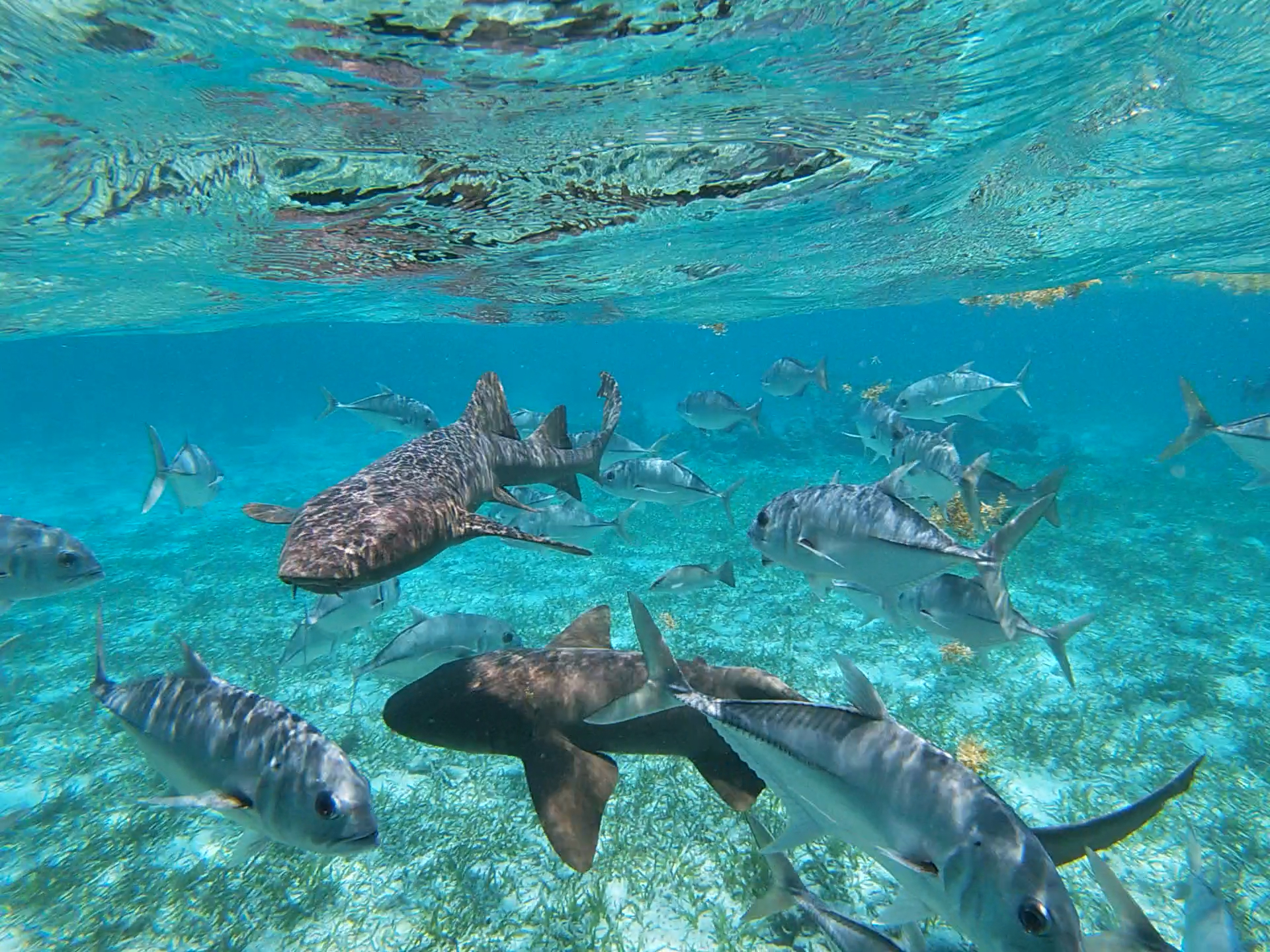
For several years, local fishermen often cleaned their catch in this area, located just inside the reef, to the south of Ambergris Caye. When fishermen noticed that their activity had attracted Nurse Sharks and several Southern Sting Rays, they reported this information to the dive operations in San Pedro, who then dispatched some divers to investigate. What they found was a bonanza, and “Shark-Ray Alley” quickly became a very popular dive site.
This is a must stop for the first introductory dive or snorkel in Belizean waters. Zone D is only 20 minutes north of Caye Caulker by power boat. Shark Ray Alley has a maximum depth of 30 feet and excellent visibility. You can almost always see all species of fish including jacks, groupers, snappers, parrot fish, angel fish, barracuda, eels, spider crabs, lobster, and nurse sharks. Divers are occasionally cautioned regarding the currents.
As soon as your boat arrives in the area, you will notice a number of dark shadows in the shallow (eight foot deep) waters. These are the sharks and rays that hear the boat approach and come in search of a few scraps of fish.
These creatures have a great tolerance for divers and snorkelers and seem to enjoy the human interaction. The rays, which have a ‘wing-span’ of two to four feet, swim directly towards the snorkelers and divers, inviting them to reach out and stroke their wings (although it’s best not to touch them). The gentle Nurse Sharks average four to six feet in length. While the animals show no fear of humans and will often swim right up to snorkelers, it is best to keep a distance and not touch the animals.
At Tsunami Adventures, we are proud to offer a “no touch policy”. We respect the marine animals in their home. We do not grab them for you to pet nor do we chase after the nurse sharks and flip them over for you to caress. This action is actually equivalent to us humans gasping for air in water. Some will say they like this, however we beg to differ.

Posted in Blog - Tsunami Adventures | Leave a comment

The Lionfish

lion fish served here

lion fish served here

lionfish

lionfish caught

You may have seen a picture of a lionfish or heard of them, but in Belize? The introduction of lionfish into the Wider Caribbean Sea is believed to have originated South Florida when several lionfish were known to have been released into the sea. The shallow tropical waters of the Bahamas has witnessed a population explosion over a period of 4 years
between 2004 and 2008. Bahamian fishermen are now harvesting lionfish for consumption since they are among
the largest fish in the sea. Don’t be surprised if you are on a tour with us and your guide attempts to kill or catch the lionfish. Lionfish are voracious predators and can consume almost 80% of juvenile fish recruits including the important
fishery export products like snappers and groupers, and parrotfish, which help keep the coral reefs clean of algae.
Lionfish are also known to eat crustaceans, like the spiny lobster. In 30 minutes a lionfish was observed eating
more than 20 fish! YIKES!!!! The local guides and fisherman have been doing a great job on the Barrier Reef and they have been on many dinner tables to enjoy.

Pterois is a genus of venomous marine fish found mostly in the Indo-Pacific, known collectively as the lionfish. Pterois is characterized by red, white and black stripes, showy pectoral fins and venomous spiky tentacles. Pterois are popular aquarium fish and are readily utilized in the culinary world.

Posted in Blog - Tsunami Adventures | Leave a comment

Caye Caulker North Side

northside beach

northside beach

Gean on the Northside

Gean on the Northside

Caye Caulker is more than just one island, it’s two. The North side and the South side, referred to as Caye Caulker Village and Northside. Caye Caulker Village is where the majority of the population lives. Electricity is supplied by BEL. There is now a water system. Shops, restaurants, hotels (57) and private homes all co-habitat on this small island of .15 to 1.2 miles wide and 5 miles long. Expect telephone, cellular, internet, satelite television,  2 banks, 1 ATM, delivery services, 1 gas station and almost everything you need. 2 cemeteries and no hospital. Airstrip that services small places to reach the city and other destinations.  The island is divided in two at the famous SPLIT. A very well known watering hole located at the North End of the CCV side. A great hang out for shady people as written on their designed t-shirts and sign. Spend the day here relaxing, swimming, snorkeling, have a few belikins, canoe, cross the split and walk the North Side. About 30 feet of water divides the two islands. At one time it was only a trickle of water between the two, until Hurricane Haitti eroded the area naturally and later locals decided to dredge enough space to pass boats to the back of the island. This was considered a short cut to the gas station.

Here is a map of Caye Caulker North Side. A great place for canoeing or kayaking. We rent one double kayak and one single kayak, plus we have 2 double canoes for rental at Tsunami Adventures. We also offer a 2 hour cruise around both island with a stop at the Reserve on the very North tip of Caye Caulker.

Visiting Caye Caulker’s NORTHSIDE. By foot, swim across or get a drop on the other side of the split. Walk the trail, make sure you bring water. A dozen more or less private homes, scattered along the main road spanning one mile North of the Split. There is talks of BEL extending it’s electricity service, but no movement yet!  At night, there is no streetlights to light your way, so make sure you have a flashlight. Another way to visit the NORTHSIDE is by canoe or kayak, circle the island or move up North on the front side or back side of the island. Usually the breeze is blowing, so going around the back, makes for a calm relaxing paddle. Cruise along the mangroves, look for seahorses, spot eagle rays forging for food and nurse sharks nesting in the shallows of the mangroves. I like to make a pit stop at the old Driftwood Dock, a great place for a swim and relax, paddle up the lagoon entrance and into the natural lagoon that is a great place to catch sprat for fishing.  This is a great location to spot crocodiles at night. We offer a crocodile night and stargazing tour starting at 7:30pm, lasting 2 hours. snacks and rum punch or non-alcoholic drinks included as well as a bright LED flashlight to search them out along with your guide in the darkness of the night. Fireflies flicker amongst the mangroves while the orion, cassiopeia and the big dipper watch over you.

Caye Caulker, Belize

Posted in Blog - Tsunami Adventures | Leave a comment

Snorkeling for Free Caye Caulker

Free Snorkeling!

You wouldn’t think we would want to tell you about free snorkeling, when we have all these wonderful tours we want you to go on.

Well, we all want somethings for free. It certainly isn’t going to be as good as a one of our reef tours, however it will surely be fun and hopefully you will be able to see lots of marine life.

If you have your own snorkeling gear, then great, if you need fins, we have them for rental for only $5BZ or $2.50USD if you need the full set. Mask, Snorkel and Fins we rent all day for $5.00USD a set. If you want a week, then you pay for 5 days rental and get two days free. It’s not entirely free but a heck of a deal.

The best place to go Snorkeling for Free is at the split. I often recommend to people to start from the end of our dock and swim around there and then onwards towards the split over the Sea grass beds, where you will see sea stars and young corals. Swim down along the seagrass edge towards the split bar area, swim along the wall, tons of fish. Dive down and under the ledge there is a few nurse sharks hiding out. You may see some lobsters hiding in the cracks. Swim accross the split and snorkel through the mangroves. Lots of fish hiding out in the mangroves.

Be careful crossing the split. Look both ways twice and then swim across fairly fast and get to the side of the mangroves.

If you are a little more adventures, swim around the whole South island of Caye Caulker. Stay close to shore. We do not recommend swimming out to the reef with out a canoe or kayak and life jackets, as well as permission from the Caye Caulker Marine Reserve.

With a good eye you can spot hidden Sea Horses wrapped around the mangrove roots.

If you have plenty of energy consider renting a canoe or kayak with a friend.  We have double canoes and 1 double kayak for rental at Tsunami Office for $25USD all day or $7.50USD an hour. You can paddle out to the Reef, with permission of the Caye Caulker Marine Reserve and a $10BZD per person fee. So this pretty much defeats the purpose of FREE SNORKELING….but if you need more information about this, then you now know it is available.

If you are a guest of Costa Maya Beach Cabanas, Canoes are included in your nightly rental rate. Another good reason to stay at Costa Maya Beach Cabanas. Not only do they offer FREE WIRELESS and BICYCLES. CANOES TOO!!!!

Consider snorkeling at the split at night for a totally different experience. Don’t be afraid of the dark. For only $5USD we rent underwater flashlights. But if you have your own then better, because it is FREE……

Posted in Tsunami Tours | Leave a comment

Eating on Caye Caulker for $10USD a day

There is a over 20 restaurants on Caye Caulker. All offering a little bit of the same and with a Twist of different flavors. There is not much for international food, but if you have a craving for Italian, there is two restaurants that specialize.  And don’t forget there is always a Chinese restaurant or take away anywhere you go in Belize.

Here is a guide to eating good food for breakfast, lunch and dinner for only $10USD total.

You don’t have to cook anything, only wait for your food to be ready.

Breakfast

Waffles to go at Jesse’s Snacks. Choose your toppings, butter, cheese or syrup. $1.00USD. She also serves fresh made tortilla with ham, cheese and beans for $2.50USD. A very filling breakfast.

Fruit plate from Julia’s Fruit Stand or Gloria’s Deals on Wheels. Bananas, pineapple, papaya & watermelon all cut up ready to eat in a nice to go container with fork for $2.50USD
A new place in the palapa area and one of my favorite places to get a fresh made smoothie of your choice of fruits for $1.50USD. They also sell fresh made fruit juices for $5USD for one liter.

Lunch

Local Favorite and usually eating by every Belizean daily. Rice and Beans or Stew Beans and Rice with Stewed Chicken with salad and plantain. This will keep you full all day   $3.50USD      This meal can be purchased at Martinez just around the corner from Oceanside or purchased to go at Glenda’s located to the back by the BTL complex.  I usually share this meal or save what I can’t eat for a snack later. The also do great burritos for $3USD

most popular meal in Belize

most popular meal in Belize

Dinner

Another favorite of ours is El Paso, just accross from the bakery, which is a must stop, more details below. El Paso is very inexpensive Spanish food. Very flavorful. I like their vegetarian burritos. Neno’s is stewed beef and beans served with your choice of fry jack or tortilla for only $4USD, enough for two to share. They also serve fresh and only .50 cents each. Garnaches, Salbutes, Tostados, Panadas and Fry Jack. This place serves breakfast, lunch and dinner.

Chinese Fried Chicken or Fried Rice or a cheese burger in paradise to go, at any of the local Chinese Takeaway, this meal can also be eaten in. Open for lunch and dinner.

Now, you can’t eat the same meal everyday, so here are some other inexpensive meals. The best is to take your food and find a nice place to relax on the beach and enjoy the view and breeze.
Homemade Meat Pies to go. For only $.50 cents USD each. Buy 3 and have a filling tasty meal. This are usually eaten for breakfast. He usually walks through the village with his cart and you know he is around as he hollers out Meat Pies…He also has these really good lemon tarts for the same price. His wife does all the cooking.

Tamales, Rubin is usually around every day, Tamales are always available on Saturday and Sunday in the morning and up to lunch time. They are $1.50USD each.  Very tasty local dish, made with corn / masa and chicken.

Chicken King, has his home made cart that is roasting chicken as he pushes his cart through the village, you can smell it as it passes by. Chicken is sold by the 1/4 chicken for $2.50USD comes with dinner roll. He also makes chicken burgers for only $2.50USD and they are delicious.

Conch Fritters usually present themselves around 4pm, a perfect time for an afternoon snack. $.75 cents only. Lots of flavor. When in season, he has lobster fritters. He also does pizza pockets for only $.50 cents each.

Tacos in the morning. These gyals start early and offer fresh juice and tacos. A order of 3 is only .50cents.
There is currently 3 or maybe four ladies offering this early from 6am. They set up on the street side, close to the water taxi area. Fresh orange juice and tacos, a local favorite, you will often see a crowd around, all waiting for their order.

Don’t forget to pass by Mrs. Eladel of Mom’s Kitchen, she makes fresh Johnny Cakes. Have your Johnny Cakes with ham and cheese or chicken and beans, or beans and cheese.. Only $.75 cents USD each.

We don’t want to forget about all of these other wonderful places that offer great food for really good prices. Glenda’s Restaurant, she has breakfast and lunch. She is also known for her homemade cinnamon rolls for only $.50 cents USD each. Make a pitt stop at the local bakery. A great place for snacks in the afternoon. My favorite is the ham and cheese flake pastry or the hotdog in a bun. Only $1.50USD

Bones aka Llyod starts from the split and walks towards the main part of the village daily starting around 4pm and offers fresh baking of Banana Breads and other cakes and cookies.

Aldame, also known as Caye Lady makes all sort of wonderful cakes for sale for $2USD each, she starts at the opposite end and works her way to Tsunami, then is back in the evening by the palapa area. She does an awesome coconut cake.
She also makes wonderful tortillas that she sells through the local stores. $1.50USD for 5 tortillas. I loves these with fresh avocado and cheese.

Conch Soup from Aunties Fast Food. Locally made and only $5.00USD comes with rice. This is enough soup for two people or save some for dinner. She has a huge variety of take a way food on her menu.

There is so much wonderful inexpensive food in Caye Caulker that is made by locals. Offering excellent food.

There is many restaurants offering Barbecues and fine cuisine. I don’t think there is a bad restaurant in Caye Caulker.

Remember that Caye Caulker’s, moto is GO SLOW.  So sit back and relax and enjoy the local cooking of Caye Caulker.


Posted in Blog - Tsunami Adventures | Comments Off

Strombus Gigas – Queen Conch

Conch Season in Belize is open from Oct 1st until June 30th

conch shell on the beach

conch shell on the beach

Try some local flavor and enjoy a bowl of Conch Soup.

Conch meat cleaned and pounded

Limes and lime juice

Veggies – plantain, carrot, potato, corn, squash, cabbage and onion.

Herbs – Cilantro and oregano

Spices – Pepper

Habenero or Marie Sharps Hot sauce

Coconut oil or butter

Water
Chicken soup base (maggie soup) or bouillon cubes

Instructions:
Pound the conch with meat pounder and cut into bite pieces. Let Conch sit in fresh water with lime. Let sit while cutting vegetables

Cut veggies into big bite size pieces. Cut corn 1/2 inch on cob. Slice th squash like orange pieces. Cut potatoes into square pieces. Plantain should be firm. Buy one that is yellow, if not ripe will taste bitter cut into half inch pieces add to soup last.

Make soup base. Heat oil, add chopped garlic, about half a garlic head and one medium size onion. Drain conch and pat dry. Add Conch to garlic and onion and brown a little. Take out conch and put aside. Add water and soup base. If you want your soup thick and creamy add one can of evaporated milk and one can of coconut milk. Sprinkle with pepper to taste.  Add your veggies, carrots and potatos first….add conch. Plantain last.

Bring to a boil and reduce heat. Meanwhile make rice. If you want your rice to have a coconut flavor add coconut milk just before it is finished. About 1 cup.

Serve your soup with a cup of rice. Cut up fresh cilantro and oregano along with habanero pepper and lime wedges.

For more information about Queen Conch go to www.strombusgigas.com

Posted in Blog - Tsunami Adventures | Leave a comment

Manatees at Caye Caulker North Point

Every year the West Indian Manatees make their way out to the reef at the North Point of Caye Caulker Marine Reserve. The manatees relax and enjoy the cooler waters of the reef. They come here to mate and they come to have the algae cleaned from their bodies from the reef fish.  We are very luckly to have seen them so often this year. At Tsunami Adventures we offer small groups, which gives you a better opportunity to see the manatees. We do not harass the manatees.

Manatee taking a breath

Manatee taking a breath

Here is some information about the Manatees.

Although their bulbous, whiskery face makes this hard to believe today, manatees are probably the source of legends about mermaids. Their humanlike eyes must have captivated the early European sailors who caught fleeting glimpses of them swimming in the warm waters of the West Indies.

In the 17th century, mermaids were depicted with their male companions, mermen. Although the legends of these half-fish, half-human creatures have lived on for hundreds of years and are still popular today, it is uncertain whether the manatees that inspired the legends will live on much longer.

Only a concerted effort to protect them in their marine habitat will save manatees from extinction.

Manatee at North Point Caye Caulker

Manatee at North Point Caye Caulker

Range and Status

Manatees inhabit warm waters of the Western Atlantic from Florida to Brazil where they live in coastal waters, freshwater inlets, and river mouths.

Although their range is quite large, manatees today exist only in a few small, isolated populations. They once were widespread in rivers and along coasts in their range, but they were hunted extensively in the 18th and 19th centuries. Coastal development has further reduced their populations. Today, there are less than 2,000 manatees remaining in the United States.

The population of manatees in Belize has varied over the past decade, but is now estimated at 300-700 individuals. Despite this seemingly low number, Belize is thought to have the highest concentration of this subspecies in the world. However, the current population is significantly lower than a century ago and is continuing to decline. What is causing the West Indian manatee to hover near extinction?

Reports of declining manatee populations due to hunting date back to 1883. In spite of the Manatee Protection Ordinance of 1935 and the more recent protection under the Wildlife Protection Act, illegal hunting has persisted. Reports of manatee bones at butcher sites is evidence that manatees are still taken for local consumption, especially in Southern Belize, but currently the primary threat is the exportation of meat to neighboring countries such as Honduras and Guatemala. Another threat exists in boat collisions with manatees; propeller-scarred manatees are becoming an increasingly common site. Moreover, as boat traffic increases, manatees are left with fewer undisturbed creeks and channels for calving and resting areas, thus they are forced to seek out less suitable habitats to avoid such harassment. In the search for habitat, manatees often find themselves susceptible to entrapment and death due to gill netting in rivers and across river mouths. Finally, it should come as no surprise that industrial and agricultural pollution, as well as effluent from domestic sewage, adversely affects the health of manatees and potentially destroys the vegetation on which they feed. Increased coastal development has made this a significant threat.

It seems that with such a high number of threats, the manatee has an uphill battle for survival. Fortunately, over the past decade, the people of Belize have made great strides in preventing further loss of this species. Public awareness campaigns and educational workshops have helped to increase enforcement of regulations. Still, more enforcement is needed to protect this species, whose fate hangs in the balance.

Natural History

The manatee is a large, bulky aquatic mammal with flippered forelimbs and a spatula-shaped tail. Manatees can grow to 12 feet in length and weigh up to 3500 pounds. They may live to be 50 years old.

The manatee diet consists entirely of vegetation, consuming at a rate of 100 pounds a day. They eat by using their divided upper lip, which is very flexible, to grasp and take in aquatic plants. Like other air-breathing marine mammals (dolphins, whales, and seals), manatees must periodically surface for air.

Females reach sexual maturity between five and nine years of age, but they do not produce many offspring; more animals are killed each year than are born. Mothers are strongly bonded to their calves, but other social ties among manatees are very loose. They are extremely gentle and have been described as incapable of aggression.

Manatees are one of four living species in the Order Sirenia, which also includes the West African manatee, the Amazonian manatee, and the dugong. Another sirenian, the Steller’s sea cow, became extinct in the 1700s. The sirenians evolved from an ancestor they share with the elephant, their closest living land relative.

Tourism

Manatees spend hours grazing underwater everyday, and they can be very exciting to watch in their natural habitat. Manatee-watching tourism gives local people a financial incentive to preserve the species, since tourists spend their dollars at local businesses. Tourists may be inspired to do something to help these beautiful and mysterious creatures.

Here in Belize, manatee-watching tourism has been a very successful conservation action. Not long ago, local people hunted manatees with rifles, while today manatees are a big attraction for tourist dollars.

Research

More scientific research is needed to understand manatees and their needs. One current study is tracking manatees by satellite to learn more about where they go and what they do. We need to know more about their calving and feeding behaviors.

www.swallowcayemanatees.org

Posted in Blog - Tsunami Adventures | Leave a comment